AKA - One-way Analysis of variance, One-way ANOVA.
Schematic with Example Data
| Level | a1 |
a2 | a3 | a4 | Total
|
| 4
6
3
3
1
3
2
2
| 4
5
4
3
2
3
4
3
| 5
6
5
4
3
4
3
4
| 3
5
6
5
6
7
8
10
|
| Mean | 3.0
| 3.5 | 4.25 | 6.25 | 4.25
|
| sd | 1.51 | 0.93 | 1.04 | 2.12 | 1.88
|
Or in abbreviated form:
| Level | a1 |
a2 | a3 | a4 | Total
|
| S1
n=8
| S2
n=8
| S3
n=8
| S4
n=8
|
| Mean | 3.0
| 3.5 | 4.25 | 6.25 | 4.25
|
| sd | 1.51 | 0.93 | 1.04 | 2.12 | 1.88
|
Where each Sj is an independent randomly assigned group of subjects.
Linear Model
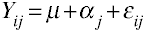
The prediction model is
where,
Yij is the score for the ith observation in the
jth treatment level
Y'j is the predicted value for the jth treatment level and is
equal to the mean of the group
μ is the overall population mean (grand mean)
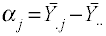
αj is the effect of A treatment level j which is equal to
μj - μ and is subject to the
restriction that Σαj = 0 over j
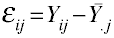
εi(j) is the error effect associated with Yij
and is equal to Yij - μ - αj .
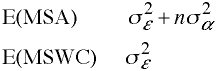
The error effect is a random variable that is
distributed NID(0,s2ε)
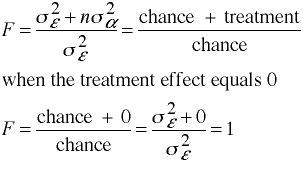
Hypotheses
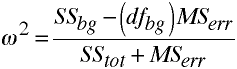
Approximately 38% of the variability of the dependent variable can be
explained by the independent variable, that is, by the differences among the
four levels of the categorical variable.
The following guidelines are suggested by Cohen (1989):
- ω2 = .01 is a small association
- ω2 = .06 is a medium association
- ω2 = .14 is a large association
By these guidelines the ω2 = .38 is very large, but this is
because the example an artificial classroom dataset.
In terms of the fhat index of effect size:
- fhat = .10 is a small effect
- fhat = .25 is a medium effect
- fhat = .40 is a large effect
These are very rough guidelines.
Note: The fhat index of effect size should not be confused with Cohen's d index
of effect size. The fhat index is derived directly form the ω2.
Model for Orthogonal Coding
G  X1  X2  X3
1   1   1   1
2  -1   1   1
3   0  -2   1
4   0   0  -3
Stata Computer Example
input y grp x1 x2 x3
 4 1  1  1  1
 6 1  1  1  1
 3 1  1  1  1
 3 1  1  1  1
 1 1  1  1  1
 3 1  1  1  1
 2 1  1  1  1
 2 1  1  1  1
 4 2 -1  1  1
 5 2 -1  1  1
 4 2 -1  1  1
 3 2 -1  1  1
 2 2 -1  1  1
 3 2 -1  1  1
 4 2 -1  1  1
 3 2 -1  1  1
 5 3  0 -2  1
 6 3  0 -2  1
 5 3  0 -2  1
 4 3  0 -2  1
 3 3  0 -2  1
 4 3  0 -2  1
 3 3  0 -2  1
 4 3  0 -2  1
 3 4  0  0 -3
 5 4  0  0 -3
 6 4  0  0 -3
 5 4  0  0 -3
 6 4  0  0 -3
 7 4  0  0 -3
 8 4  0  0 -3
10 4  0  0 -3
end

tabstat y, by(grp) stat(n mean sd var)

Summary for variables: y
     by categories of: grp

     grp |         N      mean        sd  variance
---------+----------------------------------------
       1 |         8         3  1.511858  2.285714
       2 |         8       3.5  .9258201  .8571429
       3 |         8      4.25  1.035098  1.071429
       4 |         8      6.25   2.12132       4.5
---------+----------------------------------------
   Total |        32      4.25  1.883716  3.548387
--------------------------------------------------

display 2.12132/.9258201

2.2912875

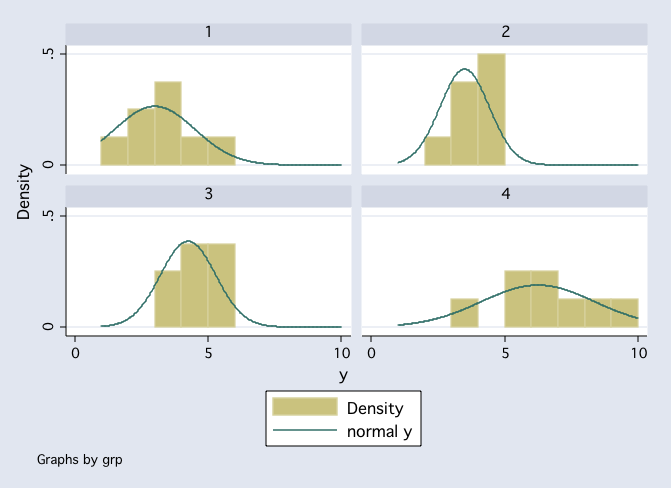
histogram y, by(grp) normal
robvar y, by(grp)   /* W0 is Levene's test of homoscedasticity */

            |            Summary of y
        grp |        Mean   Std. Dev.       Freq.
------------+------------------------------------
          1 |           3   1.5118579           8
          2 |         3.5    .9258201           8
          3 |        4.25   1.0350983           8
          4 |        6.25   2.1213203           8
------------+------------------------------------
      Total |        4.25   1.8837163          32

W0  = 1.292876   df(3, 28)     Pr > F = .29625408

W50 = 1.037037   df(3, 28)     Pr > F = .39138742

W10 = 1.292876   df(3, 28)     Pr > F = .29625408

anova y grp

                           Number of obs =      32     R-squared     =  0.4455
                           Root MSE      =   1.476     Adj R-squared =  0.3860

                  Source |  Partial SS    df       MS           F     Prob > F
              -----------+----------------------------------------------------
                   Model |       49.00     3  16.3333333       7.50     0.0008
                         |
                     grp |       49.00     3  16.3333333       7.50     0.0008
                         |
                Residual |       61.00    28  2.17857143
              -----------+----------------------------------------------------
                   Total |      110.00    31   3.5483871

/* user written program -- findit effectsize */

effectsize grp

 anova effect size for grp with dep var = y

total variance accounted for
omega2         = .37854187
eta2           = .44545455
Cohen's f      = .78046067

partial variance accounted for
partial omega2 = .37854187
partial eta2   = .44545455

/* Tukey-Kramer pairwise comparisons */
/* user written program -- findit tkcomp */

tkcomp grp

Tukey-Kramer pairwise comparisons for variable grp
studentized range critical value(.05, 4, 28) = 3.8613586

                                      mean
grp vs grp       group means          dif     TK-test
-------------------------------------------------------
  1 vs   2     3.0000     3.5000      0.5000   0.9581
  1 vs   3     3.0000     4.2500      1.2500   2.3954
  1 vs   4     3.0000     6.2500      3.2500   6.2279*
  2 vs   3     3.5000     4.2500      0.7500   1.4372
  2 vs   4     3.5000     6.2500      2.7500   5.2698*
  3 vs   4     4.2500     6.2500      2.0000   3.8326


oneway y grp, noanova sidak bonferroni scheffe

                            Comparison of y by grp
                                (Bonferroni)
Row Mean-|
Col Mean |          1          2          3
---------+---------------------------------
       2 |         .5
         |      1.000
         |
       3 |       1.25        .75
         |      0.608      1.000
         |
       4 |       3.25       2.75          2
         |      0.001      0.005      0.068

                            Comparison of y by grp
                                  (Scheffe)
Row Mean-|
Col Mean |          1          2          3
---------+---------------------------------
       2 |         .5
         |      0.927
         |
       3 |       1.25        .75
         |      0.427      0.794
         |
       4 |       3.25       2.75          2
         |      0.002      0.009      0.085

                            Comparison of y by grp
                                   (Sidak)
Row Mean-|
Col Mean |          1          2          3
---------+---------------------------------
       2 |         .5
         |      0.985
         |
       3 |       1.25        .75
         |      0.474      0.900
         |
       4 |       3.25       2.75          2
         |      0.001      0.005      0.066

/* regression with orthogonal coding */

regress y x1 x2 x3

      Source |       SS       df       MS              Number of obs =      32
-------------+------------------------------           F(  3,    28) =    7.50
       Model |       49.00     3  16.3333333           Prob > F      =  0.0008
    Residual |       61.00    28  2.17857143           R-squared     =  0.4455
-------------+------------------------------           Adj R-squared =  0.3860
       Total |      110.00    31   3.5483871           Root MSE      =   1.476

------------------------------------------------------------------------------
           y |      Coef.   Std. Err.      t    P>|t|     [95% Conf. Interval]
-------------+----------------------------------------------------------------
          x1 |       -.25   .3689996    -0.68   0.504    -1.005861    .5058614
          x2 |  -.3333333    .213042    -1.56   0.129    -.7697301    .1030635
          x3 |  -.6666667   .1506435    -4.43   0.000    -.9752458   -.3580875
       _cons |       4.25   .2609221    16.29   0.000     3.715525    4.784475
------------------------------------------------------------------------------

/* regression with dummy coding */

regress y i.grp


      Source |       SS       df       MS              Number of obs =      32
-------------+------------------------------           F(  3,    28) =    7.50
       Model |          49     3  16.3333333           Prob > F      =  0.0008
    Residual |          61    28  2.17857143           R-squared     =  0.4455
-------------+------------------------------           Adj R-squared =  0.3860
       Total |         110    31   3.5483871           Root MSE      =   1.476

------------------------------------------------------------------------------
           y |      Coef.   Std. Err.      t    P>|t|     [95% Conf. Interval]
-------------+----------------------------------------------------------------
         grp |
          2  |         .5   .7379992     0.68   0.504    -1.011723    2.011723
          3  |       1.25   .7379992     1.69   0.101    -.2617229    2.761723
          4  |       3.25   .7379992     4.40   0.000     1.738277    4.761723
             |
       _cons |          3   .5218443     5.75   0.000      1.93105     4.06895
------------------------------------------------------------------------------

/* cell means using margins command */

margins grp

Adjusted predictions                              Number of obs   =         32
Model VCE    : OLS

Expression   : Linear prediction, predict()

------------------------------------------------------------------------------
             |            Delta-method
             |     Margin   Std. Err.      z    P>|z|     [95% Conf. Interval]
-------------+----------------------------------------------------------------
         grp |
          1  |          3   .5218443     5.75   0.000     1.977204    4.022796
          2  |        3.5   .5218443     6.71   0.000     2.477204    4.522796
          3  |       4.25   .5218443     8.14   0.000     3.227204    5.272796
          4  |       6.25   .5218443    11.98   0.000     5.227204    7.272796
------------------------------------------------------------------------------
Some Formulas
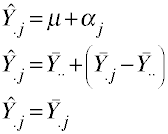
Recall the linear model,
The grand mean is the general level of scores,

The treatment effect is the elevation or depression of scores due to the jth treatment,
The error effect is unique to subject i in treatment level j,
The above implies,
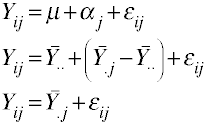
From the prediction model (way above),
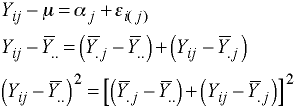
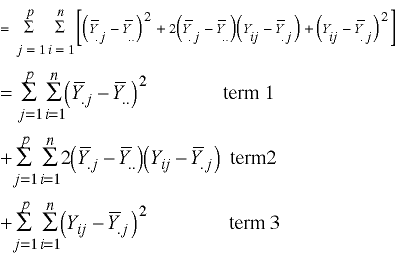
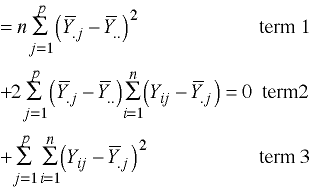
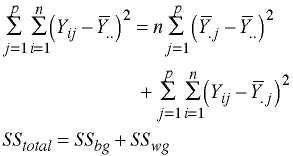
Partitioning Sums of Squares


Linear Statistical Models Course
Phil Ender, 17sep10, 11apr06, 12Feb98